
How Light Is Aerogel? Density, Weight, and the Lightest Solid Record
Silica aerogel can be as light as 3 milligrams per cubic centimeter, and graphene aerogel holds the world record at 0.16 mg/cm³, lighter than air. Here are the real density numbers and what they mean for insulated clothing.
 Graphene-X EditorialEditorial Team
Aerogel is the lightest class of solid materials known. The record holder, a graphene aerogel produced at Zhejiang University in 2013, measures 0.16 milligrams per cubic centimeter, which is lighter than air itself at about 1.2 mg/cm³. Silica aerogel, the type used in insulation and apparel, has been produced as light as 3 mg/cm³ and typically ranges from 3 to 200 kg/m³ depending on formulation. For comparison, glass, chemically the same material as silica aerogel, is roughly a thousand times denser. The lightness comes from one fact: aerogel is 95 to 99% air by volume.
This article covers the numbers, the records, what "lighter than air" actually means, and why aerogel's lightness translates directly into insulation performance.
TABLE OF CONTENTS
How light is aerogel, exactly?
Density is the clean way to answer. The numbers, with familiar materials for scale:
| Material | Typical density |
|---|---|
| Graphene aerogel (record, 2013) | 0.16 mg/cm³ (0.16 kg/m³) |
| Air (sea level) | ~1.2 mg/cm³ (1.2 kg/m³) |
| Lightest silica aerogel (JPL, 2002) | 3 mg/cm³ (3 kg/m³) |
| Silica aerogel, common range | 3 to 200 kg/m³ |
| Expanded polystyrene foam | ~11 to 30 kg/m³ |
| Down fill (lofted, in garment) | ~5 to 30 kg/m³ |
| Water | 1,000 kg/m³ |
| Glass (same chemistry as silica aerogel) | ~2,500 kg/m³ |
Two things stand out. First, the lightest aerogels overlap with or undercut the density of air. Second, even ordinary commercial silica aerogel is in foam territory while insulating far better, for reasons covered below.
The structure explains the numbers. Aerogel is made by forming a wet gel and then extracting the liquid without letting the solid nanostructure collapse. What remains is a three-dimensional skeleton of nanoparticles enclosing pores of roughly 2 to 50 nanometers. The skeleton is a tiny fraction of the volume. The rest, 95 to 99% and up to 99.8% in laboratory formulations, is air.
Is aerogel the lightest solid in the world?
Yes. The Guinness World Records title for least dense solid has belonged to aerogels for decades, and the record has been beaten by newer aerogels each time.
The 2002 record went to a silica aerogel developed by Dr. Steven Jones at NASA's Jet Propulsion Laboratory, at 3 mg/cm³, displacing a previous 5 mg/cm³ holder. In 2013 a team at Zhejiang University in China produced a graphene aerogel at 0.16 mg/cm³, which has held the record since. Graphene aerogel is built from a network of reduced graphene oxide rather than silica, and beyond the record it is electrically conductive, which points at sensing and smart-textile applications rather than pure insulation.
One clarification the record invites: a material less dense than air does not float away. The measurement excludes the air filling the pores; in practice the pores contain air, so a block of it rests in your hand, nearly weightless.
Is aerogel actually a solid?
Yes. Despite the name and the "frozen smoke" nickname, aerogel is a rigid, dry solid. The "gel" refers to how it is made, from a wet gel precursor, and the "aero" to what replaces the liquid. It holds its shape, it can be machined, and NASA used solid blocks of it to catch comet dust on the Stardust mission precisely because it is a stable solid with extraordinarily low density.
The material also predates its space-age image: chemist Samuel Kistler created the first aerogel in 1931 and published it in Nature, decades before NASA existed.
Why is aerogel called frozen smoke?
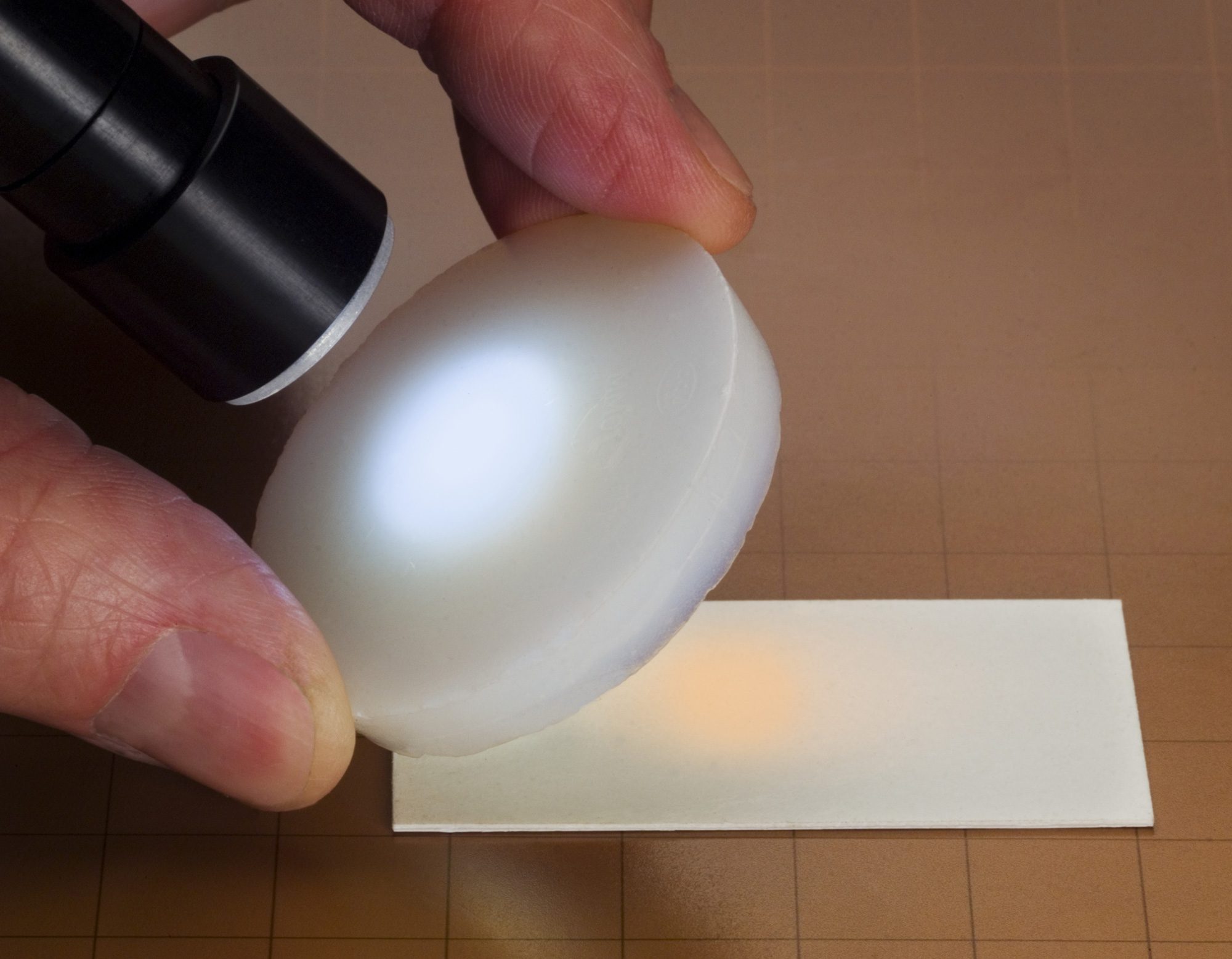
Because that is what it looks like. Silica aerogel is translucent with a faint blue haze, the same effect that makes the sky blue: its nanostructure scatters short blue wavelengths of light more than long red ones. Hold a block against a dark background and it reads as a captured wisp of smoke. Hold it in your hand and the impression completes itself, since a palm-sized block weighs about as much as the air around it. NASA's Jet Propulsion Laboratory popularized the nickname, along with "solid smoke" and "solid cloud," during the years its aerogels were flying on Mars Pathfinder and Stardust.
The nickname is also a useful correction. Frozen smoke sounds fragile and temporary. The material is neither: it is thermally stable, dry, and chemically the same silica as glass. Only the density changed.
How is something this light made?
Aerogel starts as a wet gel: a solid nanostructure formed throughout a liquid, similar in principle to gelatin. The manufacturing problem is removing the liquid. Let it evaporate normally and capillary forces pull the nanostructure inward as the liquid retreats, collapsing the pores and leaving a dense, shrunken solid.
The classical solution is supercritical drying. The liquid in the gel is exchanged for one that can be taken past its critical point, typically carbon dioxide, where the distinction between liquid and gas disappears. With no liquid-gas boundary there are no capillary forces, and the fluid can be vented off leaving the nanostructure standing, full of air, at 95 to 99% empty space. The process works, and it is the reason aerogel exists, but it requires high-pressure equipment, solvent exchanges, and significant energy. It still accounted for roughly 70% of aerogel production as of 2025, and it is the main reason aerogel remains a premium material.
Two newer routes are changing the cost curve. Ambient pressure drying chemically treats the gel so it can survive ordinary evaporation, removing the high-pressure step. Freeze-drying, used especially for newer cellulose-based aerogels, sidesteps capillary collapse by sublimating the frozen liquid directly to gas. Both point at cheaper aerogel over time, which matters for apparel, where the material cost currently keeps aerogel insulation in the premium tier.
How big is 1 kg of aerogel?
At the JPL record density of 3 mg/cm³, one kilogram of aerogel occupies about 333 liters, roughly the volume of a large bathtub or two full-size checked suitcases. At a common commercial density of 100 kg/m³, one kilogram still fills 10 liters, about a carry-on toiletry allowance times ten.
Flip the comparison to clothing terms: the entire insulation system of a winter jacket built on aerogel-based fill can run in the low hundreds of grams. The AeroGraph Puffer Jacket carries 160 g/m² of aerogel-and-graphene-integrated fill inside a complete 830-gram jacket rated from -20°C to +20°C. Lightness is the point of the material, and it carries through to the finished garment.
How strong is aerogel? Is it brittle?
Both answers are true at once, and the distinction matters.
Relative to its weight, aerogel is strong: silica aerogel can support many times its own mass in compression, which is part of why it works as a structural insulation material. In absolute terms, monolithic aerogel is brittle. Press a bare block hard enough and the sparse silica network shatters like glass. Raw blocks also shed fine dust.
This is why no serious garment contains bare aerogel. Apparel-grade formats were engineered specifically to remove the brittleness: aerogel particles blended into flexible fiber fill, aerogel formed inside fiber-reinforced blanket matrices (the approach that came out of NASA-funded work), and aerogel encapsulated inside engineered structures, which is the format behind Weather Adaptive Insulation. In those formats the fragility question moves from the material to the garment, where it is answered by construction and testing.
The fuller picture of how aerogel gets into garments, and what it does there, is in Aerogel Insulation in Clothing: What It Is, How It Works, and What It Does Not Do.
Why lightness equals insulation
Aerogel's density and its insulating power are the same property viewed from two angles.
Heat crosses an insulation layer by conduction through solid material, convection of air inside it, and radiation. Aerogel is almost entirely air, so there is very little solid to conduct heat. And the air it contains is trapped in pores smaller than the distance air molecules travel between collisions, so it cannot circulate and convect. That second effect, the Knudsen effect, is why aerogel insulates better than the still air that down and synthetic fills work by trapping: measured thermal conductivity for silica aerogel runs roughly 0.012 to 0.020 W/m·K against about 0.024 W/m·K for still air.
The practical consequence: insulation performance per millimeter that loft-based fills cannot match, from a material that adds almost no weight. Low density is not a curiosity here. It is the mechanism.
What this means in clothing
The numbers above set the ceiling; garment engineering decides what reaches the wearer. In Graphene-X outerwear, aerogel works in two systems. GRAPHINSULATE blends aerogel with graphene-integrated polyester fill for warmth at low weight. Weather Adaptive Insulation (W.A.I.) seals aerogel inside tubes that respond to temperature, inflating into a thicker insulating layer in the cold and reversing in warmth. The system received the ISPO Award in 2024, and both systems are documented on Our Tech. The garments built on them are in the Aerogel Jackets collection.
FAQ
FAQ
Frequently asked questions
How light is aerogel?
The lightest aerogel on record, a graphene aerogel, measures 0.16 mg/cm³, less dense than air. Silica aerogel, the type used in insulation and clothing, has been made as light as 3 mg/cm³ and commonly ranges from 3 to 200 kg/m³.
Is aerogel the lightest solid material in the world?
Yes. Aerogels have held the Guinness World Records title for least dense solid for decades. The current record belongs to a graphene aerogel produced at Zhejiang University in 2013 at 0.16 mg/cm³.
Is aerogel lighter than air?
The record graphene aerogel's solid structure is less dense than air (0.16 vs about 1.2 mg/cm³). It does not float, because its pores fill with air. Silica aerogels used commercially are denser than air but far lighter than any conventional solid.
Is aerogel a solid?
Yes. Aerogel is a rigid, dry solid. The name reflects its manufacturing route: it starts as a wet gel, and the liquid is replaced by gas without collapsing the solid nanostructure.
What percentage of aerogel is air?
Typical commercial silica aerogels are 95 to 99% air by volume. Laboratory formulations reach 99.8%. The remaining fraction is the solid nanostructure, silica in the most common type.
How strong is aerogel?
Relative to its weight, aerogel is strong in compression and can support many times its own mass. In absolute terms, bare monolithic aerogel is brittle, which is why clothing uses fiber-blended, blanket-matrix, or encapsulated formats instead.
Is aerogel brittle?
Monolithic aerogel is brittle and can shatter under a firm press. Apparel-grade formats solve this by blending aerogel into flexible fill, forming it inside fiber matrices, or sealing it inside engineered structures such as W.A.I. tubes.
Why is aerogel such a good insulator?
It is almost entirely air trapped in nanoscale pores. The sparse solid conducts little heat, and pores smaller than air molecules' mean free path stop convection (the Knudsen effect). Silica aerogel's thermal conductivity, roughly 0.012 to 0.020 W/m·K, is below that of still air.
Why is aerogel called frozen smoke?
Because of its appearance and weight. Silica aerogel is translucent with a blue haze from light scattering in its nanostructure, and a palm-sized block is nearly weightless. NASA's JPL popularized the nickname during the Mars Pathfinder and Stardust era.
What is aerogel made of?
The most common aerogels are silica-based, chemically the same as glass or sand. Other families exist: carbon aerogels, polymer aerogels, cellulose-based bio-aerogels, and graphene aerogels, which hold the current density record and add electrical conductivity.
Who invented aerogel?
Chemist Samuel Kistler created the first aerogel in 1931 and published the work in Nature. NASA later developed the flexible aerogel formats used on Mars Pathfinder and Stardust, which led directly to aerogel insulation in outerwear.
Sources and further reading
NASA JPL, "Guinness Records Names JPL's Aerogel World's Lightest Solid," 2002.
New Atlas, reporting on the Guinness World Records graphene aerogel record, Zhejiang University, 2013.
NASA, "Aerogels: Thinner, Lighter, Stronger."
NASA Spinoff, "Aerogel Insulation," 1998, and "Aerogel Insulation Makes Thinner, Warmer Outerwear," 2018.
APS News, "May 1931: Publication of the Creation of the First Aerogel," 2021.
Peer-reviewed measurement study of silica aerogel thermal conductivity, PMC (NIH), 2024.
ScienceDirect, Aerogel, Materials Science topic collection.
Graphene-X internal product documentation.
- #aerogel density
- #lightest solid
- #aerogel
- #silica aerogel
- #graphene aerogel
- #aerogel properties
- #frozen smoke
- #advanced materials
- #aerogel weight
Advanced Materials, Applied
The insulation built on these numbers
Weather Adaptive Insulation and GRAPHINSULATE put aerogel to work in outerwear rated for real conditions.
Featured collection
AEROGEL JACKETS


Shop
Featured in this story
Related
Related Reading
More from the journal