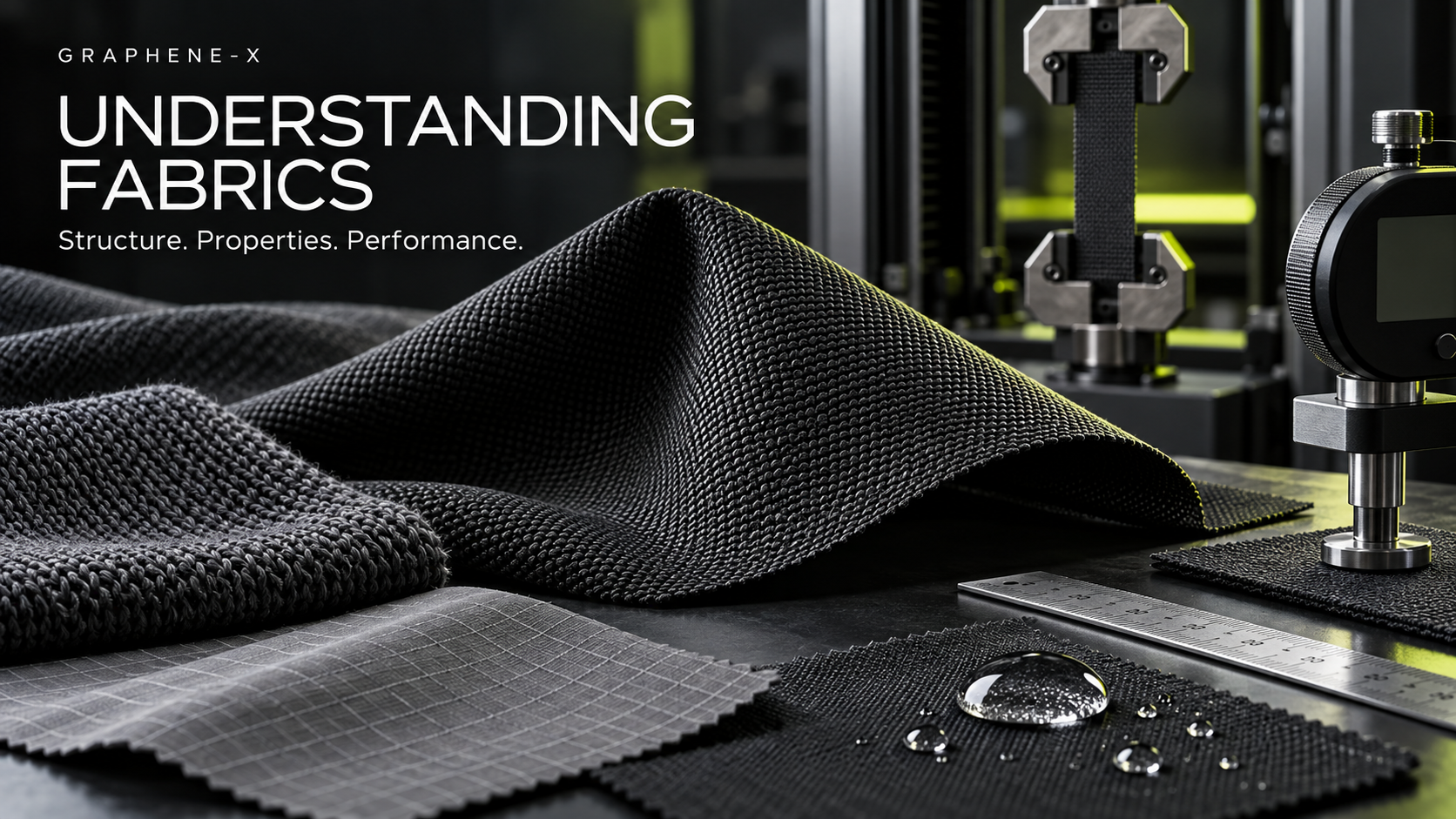
How to Understand Fabrics: A Complete Guide to Specs, Tests and Labels
A plain-language guide to every number on a fabric spec sheet: construction, fiber, yarn count, GSM, waterproof and breathability ratings, durability tests, PFAS rules, labels and graphene claims.
 Graphene-X EditorialEditorial Team
Understanding a fabric comes down to five things on its spec sheet: how it is built, what fiber and yarn it uses, how much it weighs, how it is finished, and how it performed in standardized tests. Every performance claim on a garment, from "20K/20K waterproof" to "UPF 50+", traces back to one of those five. This guide explains each term in plain language, gives the unit and the test standard behind it, and shows how to separate a verified number from a marketing one.
It is built on the textile testing and compliance glossary prepared for Kyograph, the B2B graphene-integrated textile line from Graphene-X, and opened up for anyone who buys, designs or simply wants to understand technical clothing.
TABLE OF CONTENTS
Fabric specs at a glance
If you only read one section, read this one. Each row is a question a spec sheet should answer, with the unit it uses and the test that produces the number.
| Spec | What it tells you | Unit | Common test standard |
|---|---|---|---|
| Construction | Woven, knit or nonwoven, and the exact structure | Name, e.g. ripstop, single jersey | Declared on the spec sheet |
| Composition | Fiber content by weight | % | ISO 1833 fiber analysis |
| Yarn count | How thick the yarn is | D, dtex, tex, Ne, Nm | Declared by the mill |
| Fabric weight | Mass per area | GSM (g/m²) or oz/yd² | Weighed swatch |
| Waterproofness | Water pressure held before leaking | mm (hydrostatic head) | ISO 811, AATCC 127 |
| Breathability | How easily sweat vapor escapes | g/m²/24h (MVTR) or Ret | ASTM E96, JIS L 1099, ISO 11092 |
| Warmth | Resistance to heat loss | Rct, CLO | ISO 11092 |
| Cool touch | Heat pulled from skin on first contact | Qmax | JIS L 1927, GB/T 35263 |
| Abrasion | Rubs before the fabric breaks down | Cycles | ISO 12947-2, ASTM D4966 |
| Pilling | Surface fuzz after rubbing | Grade 1 to 5 | ISO 12945-2 |
| UV protection | Share of UV blocked | UPF | AS/NZS 4399, AATCC 183, EN 13758-1 |
| Chemistry | Restricted substances present | mg/kg, ppb | REACH Annex XVII, OEKO-TEX |
A spec that gives a number without the test standard is incomplete. The same fabric can produce very different numbers under different methods, which is the single most important idea in this guide.
How fabric is built: woven, knit and nonwoven
Every fabric belongs to one of three families. The family decides how it stretches, how it holds its shape and where it gets used.
- Woven fabric interlaces two sets of yarns at right angles. It is dimensionally stable, with limited stretch unless elastane is added. Outerwear shells, workwear and bags are mostly woven.
- Knitted fabric is built from interlocking loops of yarn. It stretches and recovers naturally, which is why base layers, T-shirts and compression wear are mostly knit.
- Nonwoven fabric bonds or entangles fibers directly, with no weaving or knitting. It shows up in interlinings, filters and some insulation layers.
Woven fabric: warp, weft and weave
The warp is the set of yarns running lengthwise, held under tension on the loom. The weft (also called fill) runs crosswise and is passed over and under the warp. The warp direction is usually the stronger one and the standard grain for cutting garments. The selvedge is the finished edge along the warp; it is excluded when calculating usable width.
Density in a woven is written as warp ends by weft picks per centimeter or inch, for example "115 × 56". A higher count with fine yarns means a denser fabric, but only when yarn size is considered alongside it.
| Weave | How it is made | What it does | Where you see it |
|---|---|---|---|
| Plain | Each weft yarn goes over one warp, under the next | Firm, stable, breathable, prints well | Linings, shirting, technical shells |
| Twill | Weft passes over two or more warps in an offset step, creating a diagonal line | Softer drape, strong, resists tearing and wrinkling | Chinos, denim, workwear, softshells |
| Satin | Weft floats over many warps with minimal interlacing | Smooth and lustrous, less abrasion resistant | Linings, dresswear |
| Ripstop | Thicker reinforcing yarns woven into a grid at regular intervals | Limits how far a tear can travel at low weight | Shells, down jackets, tents, tactical wear |
| Oxford | A 2 × 2 basket variation of plain weave | Durable, textured, breathable | Shirts, bags |
| Dobby and jacquard | Machine-controlled patterned weaves | Texture or pattern built into the fabric | Technical sportswear, upholstery |
A ripstop grid is a design intent. Its real value shows up in tear-strength data, covered in the durability section below. The Nomad(e) Ultralight Waterproof Jacket uses a ripstop nylon face for exactly this reason: low weight with a structure that stops small tears from running.
Knit fabric: wales, courses and gauge
A wale is a vertical column of loops, the knit equivalent of the warp. A course is a horizontal row of loops, the equivalent of the weft. Knits usually stretch more across the wales than along them.
Gauge is the number of needles per inch on the knitting machine. Higher gauge means finer needles and finer fabric. Fine gauges around 24GG and above are typical for performance base layers; coarse gauges are used for sweater knits and fleece.
| Knit | Structure | What it does | Where you see it |
|---|---|---|---|
| Single jersey | Simplest weft knit, one set of needles | Smooth face, light, airy; edges can curl | T-shirts, base layers, underwear |
| Interlock | A double knit with two interlocked layers | Smooth on both sides, stable, no curl | Premium sportswear, activewear |
| Rib (1×1, 2×2) | Alternating knit and purl columns | High stretch and recovery | Cuffs, collars, fitted layers |
| Piqué | Textured surface from tuck stitches | Breathable, holds shape | Polo shirts, performance tops |
| Terry and fleece | Looped or brushed pile on the back | Traps air for warmth, absorbs moisture | Sweatshirts, mid-layers |
| Mesh | Open structure with visible holes | Maximum airflow, low heat retention | Vent panels, linings, jerseys |
| Tricot | Warp knit with yarns looped lengthwise | Smooth, stable, snag resistant | Activewear, linings, swimwear |
Where stretch comes from
Knits stretch mechanically because their loops rearrange under load. Elastane (also sold as spandex, or under the Lycra® brand) adds recovery, the ability to snap back. Even a few percent of elastane changes how a fabric moves. The face fabric of the Everything Proof Jacket is 95% graphene-integrated nylon and 5% spandex, enough for freedom of movement in a woven shell.
- 2-way stretch means stretch in one direction, common in wovens with elastane in the weft only.
- 4-way stretch means stretch and recovery in both length and width, usually from elastane plus a knit or a stretch woven construction.
A stretch claim only counts if recovery is reported alongside elongation. See the stretch and recovery tests below.
Fiber and yarn: what the composition line really tells you
The composition line lists fiber content by weight, in descending order. It tells you what the fabric is made of. It does not tell you how the yarn was spun, how the fabric was finished, or how it performs, which is why fiber alone never settles a performance question.
Natural, regenerated and synthetic fibers
| Fiber | Family | Strengths | Trade-offs |
|---|---|---|---|
| Cotton | Natural, plant | Soft, breathable, absorbent | Holds moisture, so it dries slowly during heavy sweating |
| Wool and merino | Natural, animal | Thermoregulating, odor resistant, moves moisture as vapor | Fine grades cost more; needs careful washing |
| Viscose (rayon) | Regenerated cellulose | Soft, drapes well | Weak when wet; conventional process uses harsh chemistry |
| Modal | Regenerated cellulose | Softer than viscose, better wet strength | Similar process family to viscose |
| Lyocell | Regenerated cellulose | Strong wet and dry, smooth | Quality depends on the producer's solvent loop |
| Polyester | Synthetic | Durable, quick drying, low cost | Prone to holding odor without a functional treatment |
| Nylon (polyamide) | Synthetic | Lighter and softer than polyester, high abrasion resistance | Costs more than polyester |
| Elastane (spandex) | Synthetic | 500 to 800% elongation, strong recovery | Used in small percentages; sensitive to heat and chlorine |
Lyocell is made by dissolving wood pulp in an amine-oxide solvent (NMMO) that is recovered and reused. In Lenzing's TENCEL™ process, more than 99% of the solvent is recovered in a closed loop, according to the WRAP Clothing Knowledge Hub.
Merino micron: why lower numbers feel softer
Wool is graded by mean fiber diameter in microns (μm). A thinner fiber bends more easily against skin, which is why low-micron merino feels soft instead of itchy.
| Micron range | Category | Feel | Typical use |
|---|---|---|---|
| Under 15 μm | Superfine | Extremely soft, rare | Luxury knitwear |
| 15 to 18.5 μm | Fine merino | Comfortable next to skin | Performance base layers |
| 18.5 to 22 μm | Medium merino | Soft, near the itch threshold | Mid-layers, socks |
| 22 to 30 μm | Crossbred | Can feel scratchy on sensitive skin | Knitwear, outerwear |
| Over 30 μm | Coarse wool | Noticeable itch for most people | Rugs, heavy outerwear |
The Timeless Merino Short Sleeve uses 16.5-micron Australian merino at 70%, blended with 30% graphene-integrated nylon. The merino handles temperature regulation, odor resistance and moisture; the graphene-integrated nylon adds structure and durability.
Brand names versus generic names
Lycra® is a brand of elastane. Spandex is the US generic term and elastane the international one; all three describe the same polyurethane-based fiber class. TENCEL™ is Lenzing's brand of lyocell, and not all lyocell is TENCEL™. Labels must use the generic name. A trademark can appear alongside it only with a license.
Filament and staple yarns
Filament yarns are made from continuous long fibers. They are smooth, strong and low-lint. Most synthetics are filament. Staple yarns are spun from short fibers, which is how all cotton and wool yarn is made. Spun yarns are softer and bulkier, with a higher tendency to pill.
Filament yarns come in three common forms:
- FDY (fully drawn yarn): flat and smooth, no texture. Used for woven shells and linings.
- DTY (draw textured yarn): heated, twisted and set into tiny permanent crimps. Soft and springy, standard in activewear.
- ATY (air textured yarn): blasted through an air jet so filaments tangle into loops. Bulky and matte, with a cotton-like hand.
Composite yarns combine materials in one strand. A core-spun yarn wraps staple fibers around an elastane core, for stretch with a cotton-like surface. A covered yarn winds a filament in a neat helix around elastane, which protects the elastane from heat, chlorine and UV.
Yarn count: denier, dtex, tex, Ne and Nm
Yarn count describes how thick a yarn is. There are two kinds of system, and they run in opposite directions.
- Direct systems fix the length and weigh the yarn. A bigger number means a thicker, heavier yarn.
- Indirect systems fix the weight and measure the length. A bigger number means a finer yarn.
| System | Definition | Direction | Mostly used for |
|---|---|---|---|
| Denier (D) | Grams per 9,000 m | Bigger = thicker | Filament yarns, global and Asian specs |
| Decitex (dtex) | Grams per 10,000 m | Bigger = thicker | Filament yarns, EU and technical specs |
| Tex | Grams per 1,000 m | Bigger = thicker | Technical textiles, nonwovens |
| Ne (English cotton count) | 840-yard hanks per pound | Bigger = finer | Cotton and spun yarns |
| Nm (metric count) | Meters per gram | Bigger = finer | Wool and wool blends |
The definitions of denier, decitex and tex follow the standard textile units summarized on Wikipedia's units of textile measurement.
Quick conversions from denier:
| From denier to | Formula | Example for 70D |
|---|---|---|
| dtex | Denier × 1.111 | About 78 dtex |
| tex | Denier ÷ 9 | About 7.8 tex |
| Nm | 9,000 ÷ Denier | About 129 Nm |
| Ne | 5,315 ÷ Denier | About 76 Ne |
Reading "75D/72f"
The number after the slash is the filament count: how many individual filaments make up the yarn. "75D/72f" means a 75-denier yarn built from 72 filaments. At the same denier, more filaments means each filament is finer, so the fabric feels softer and silkier. Fewer filaments means coarser filaments and a crisper, more structured hand.
On wovens, denier is often given for both directions, for example "70D × 100D ripstop nylon". As a rough guide, 20D reads as sheer, 40D as light performance fabric, 70D as a standard mid-weight shell, and 300D and up as bags, packs and heavy workwear.
Weight, width and stability: GSM and the commercial basics
GSM
GSM is grams per square meter, the most widely used measure of fabric weight. You can check it yourself: cut a 10 × 10 cm swatch, weigh it in grams and multiply by 100. The US equivalent is ounces per square yard; multiply oz/yd² by about 33.9 to get GSM.
| GSM range | Category | Typical use |
|---|---|---|
| 80 to 130 | Ultralight | Sheer shells, linings, light base layers |
| 130 to 200 | Midweight | T-shirts, activewear |
| 200 to 350 | Heavy | Fleece, mid-layers, heavy knits |
| 350 and up | Technical heavy | Outerwear, workwear |
These ranges are indicative. Two real examples: the Layer-X Air and its synthetic sister shirts share one 140 gsm fabric platform, while Timeless Merino sits at 205 gsm. On a laminated shell, always ask whether GSM refers to the face fabric alone or the full laminate, because the difference can be large.
Width and usable width
Width is the full roll including the selvedge. Usable width is what can actually be cut. Common widths run around 145 to 150 cm for circular knits and 152 cm for many wovens. Usable width drives fabric yield and the cost of every garment, so it is the number a buyer should always ask for.
Shrinkage and dimensional stability
Dimensional stability is a fabric's ability to keep its size after washing and drying. It is tested to ISO 6330 for home laundering and reported as a percentage in each direction, for example "3% warp, 2% weft after 5 washes at 40°C". Many buyers set a limit in the 3 to 5% range.
Hand feel and drape
Hand feel is how a fabric feels to the touch: soft, crisp, silky, peached, slippery. Drape is how it hangs. Both are subjective and are judged against an approved reference sample. Hand feel is usually the first thing a buyer checks at a trade fair, and a functional additive should leave it unchanged.
Commercial terms you will see
- MOQ: the minimum order quantity a mill accepts, often per color or construction.
- MCQ and MDQ: minimum cutting quantity and minimum dyeing quantity, which can differ from the headline MOQ.
- Lead time: typically 60 to 120 days for custom development and 30 to 60 days for stock fabrics.
- Lab dip and strike-off: small color and print samples approved before bulk production.
- Greige goods: fabric fresh off the loom or knitting machine, before dyeing and finishing.
- Lot or shade variation: color or weight differences between dye batches. Good mills number lots and group shades.
Waterproof and breathable: DWR, coatings, membranes and laminates
Weather protection is where spec sheets carry the most numbers and the most confusion. Four layers of technology are involved, and each does a different job.
DWR: the repellent finish on the outside
DWR (durable water repellent) is a finish on the outer face that makes water bead and roll off. It keeps the face fabric from soaking up water. Waterproofing itself comes from a coating or membrane underneath, so a DWR-only fabric will still pass water under pressure.
DWR matters even on fully waterproof jackets. When it wears off, the face fabric "wets out" and saturates. The membrane still blocks rain, but breathability drops because the vapor gradient that pushes sweat outward collapses. That is why care labels for shells call for technical washes and reproofing.
DWR chemistry is changing fast. Older C6 fluorocarbon finishes are PFAS based. Fluorine-free finishes, often called C0 or PFAS-free DWR, use silicone, wax or dendrimer chemistry. The regulatory deadlines driving this shift are covered in the chemical compliance section below.
Coatings and membranes
A coating is a liquid polymer, usually polyurethane (PU), spread on the back of a fabric and cured into a continuous barrier. Coatings are cost-effective and waterproof, with lower breathability. Silicone coatings appear on ultralight gear; PVC coatings are heavy and essentially non-breathable.
A membrane is a separate thin film bonded to the fabric. There are three main types:
- Microporous ePTFE contains billions of pores too small for water droplets and large enough for vapor molecules. Fast vapor transfer; pores can clog with dirt or detergent over time.
- Hydrophilic (monolithic) PU has no pores. Vapor is absorbed and passed along the polymer chains, which makes it more resistant to contamination and more dependent on humidity and temperature.
- Electrospun nanofiber membranes use ultrafine fibers to create a very open, air-permeable structure.
2-layer, 2.5-layer and 3-layer
| Construction | Structure | Character | Typical use |
|---|---|---|---|
| 2L | Face fabric plus membrane, with a separate hanging liner | Light and soft; liner adds bulk | Travel and urban jackets |
| 2.5L | Face fabric plus membrane plus a printed protective layer | Light, packable, no liner | Active outdoor, running shells |
| 3L | Face fabric, membrane and backer fabric bonded together | Most durable and structured | Mountaineering, workwear |
Watch the wording. Some spec sheets say "PU laminated" when the fabric is only PU coated. Always ask whether there is a real membrane, what type it is, and how it is bonded.
Hydrostatic head: what 10K and 20K mean
Hydrostatic head (HH) measures waterproofness. A column of water is stacked on the fabric, or the equivalent pressure is applied, until water penetrates. The result is the height of that column in millimeters. The method is defined in ISO 811 and AATCC 127, and the result depends on both the fiber and the fabric construction.
| HH rating | Common reading | Real-world use |
|---|---|---|
| Under 1,000 mm | Water resistant only | Light drizzle |
| 1,000 to 5,000 mm | Shower resistant | Short exposure to rain |
| 5,000 to 10,000 mm | Waterproof for most rain | Heavy rain, hiking |
| 10,000 to 20,000 mm | Highly waterproof | Technical outdoor, skiing |
| Over 20,000 mm | Extreme | Storms, mountaineering |
On a jacket, "20K/20K" means a hydrostatic head of 20,000 mm and a vapor transmission rate of 20,000 g/m²/24h. The Everything Proof Jacket carries a 20K/20K rating with a PU membrane and taped seams. The Nomad(e) jacket is rated 10K/10K, tuned for an ultralight emergency layer. Fabric ratings describe the fabric; real protection also depends on seams, zips, hood design and fit.
Breathability: MVTR and Ret
Breathability is the rate at which sweat vapor escapes. Two metrics dominate:
- MVTR (moisture vapor transmission rate) counts grams of vapor passing through a square meter in 24 hours. Higher is more breathable. Measured with cup methods such as ASTM E96 and JIS L 1099.
- Ret (resistance to evaporative heat transfer) measures how much the fabric resists vapor, using a sweating hotplate that simulates skin under ISO 11092. Lower is more breathable.
| Ret value | Breathability |
|---|---|
| 0 to 6 | Extremely breathable |
| 6 to 13 | Very breathable |
| 13 to 20 | Breathable |
| Over 20 | Low breathability |
Here is the catch. Cup methods and hotplate methods differ in setup, conditions and units, so their results cannot be compared directly and do not always correlate, as reviews by SGS and the Hohenstein Institute explain. Inverted-cup methods such as JIS L 1099 B1 tend to produce the highest numbers. A breathability figure without its test method is close to meaningless.
Lab numbers also have limits in the field. In hot, humid conditions or during hard effort, mechanical ventilation often matters more than the membrane. That is why serious shells add pit zips: the Everything Proof Jacket has double pit zippers for this reason.
Thermal specs: warmth, cooling and cool touch
Thermal properties measure two opposite things. Insulation measures how well a fabric keeps heat in. Conductivity and cool touch measure how fast it moves heat away.
| Metric | What it measures | Unit | Higher means |
|---|---|---|---|
| Rct (thermal resistance) | Resistance to dry heat loss, on a heated plate (ISO 11092) | m²·K/W | Warmer |
| CLO | Clothing insulation; 1 CLO equals 0.155 m²·K/W | CLO | Warmer |
| TOG | Bedding insulation; 1 TOG equals 0.1 m²·K/W | TOG | Warmer |
| Thermal conductivity (λ) | Rate heat flows through a material | W/(m·K) | Cooler, faster heat transfer |
| Qmax | Peak heat flow from skin at first contact | W/cm² | Cooler to the touch |
One CLO was originally defined as the insulation a person at rest needs to feel comfortable at 21°C, roughly a business suit, according to the extremtextil CLO reference. A heavy down jacket sits around 2 to 3 CLO.
Qmax captures the instant cool sensation when fabric touches skin. A warm probe is pressed on the fabric and the peak heat flow is recorded. NC State's Textile Protection and Comfort Center describes a higher Qmax as faster heat movement from body to fabric, which reads as a cooler feel. Qmax describes first touch. It does not prove sustained cooling during activity, which needs separate evaluation.
Materials with high thermal conductivity raise Qmax. Boron nitride, used in GRAPHCOOL™ fabrics, conducts heat well and pulls warmth away from skin, which is why those fabrics feel cool to the touch. Graphene's conductivity works in the other direction inside GRAPHTHERMAL™ fleece, spreading body heat across the surface to reduce cold spots.
The graphene conductivity trap
Single-layer graphene has been measured at roughly 4,800 to 5,300 W/(m·K) near room temperature, in the landmark study by Balandin and colleagues. That number describes a suspended, atom-thin sheet in a lab. A knitted or woven fabric is mostly polymer and air, so a graphene-integrated fabric measures in the same low range as other textiles. Quoting the raw material value as a fabric property is one of the most common errors in graphene marketing. The honest metrics for a fabric are its own Qmax, heat distribution or thermal resistance results.
If a fabric claims far-infrared (FIR) function, ask for the exact method and the emissivity result. There is no single harmonized EU apparel standard for FIR claims.
Durability tests: abrasion, pilling, tear and strength
Durability tests all ask one question: how much punishment can a fabric take before it fails? Each simulates a different kind of stress.
| Test | What it simulates | Result | Standard |
|---|---|---|---|
| Martindale abrasion | Repeated rubbing, like an elbow on a rough surface | Rub cycles to breakdown | ISO 12947-2, ASTM D4966 |
| Martindale pilling | Surface fuzz and pills from rubbing | Grade 1 to 5 (5 = no change) | ISO 12945-2 |
| Tensile strength | Pulling a strip until it breaks | Newtons | ISO 13934-1/2 |
| Tear strength | Continuing a tear that has started | Newtons | ISO 13937, ASTM D1424 |
| Bursting strength | Pushing through the fabric from one side, used for knits | kPa | ISO 13938 |
| Seam strength and slippage | Stress on a sewn seam | Newtons, gap opening | ISO 13935, ISO 13936 |
| Snag resistance | Loops pulled from the surface | Rating 1 to 5 | ASTM D3939 |
In the Martindale abrasion test, the end point for a woven fabric is reached when two separate threads are completely broken, and for a knit when one broken thread opens a hole, as defined in EN ISO 12947-2. Abrasion and pilling are separate results. A fabric can survive many rubs and still pill.
Indicative Martindale targets used in buyer specifications:
| End use | Typical minimum |
|---|---|
| Casual and fashion | 10,000 to 20,000 rubs |
| Sportswear and activewear | 20,000 to 40,000 rubs |
| Outdoor and technical | 40,000 to 80,000 rubs |
| Workwear | 100,000 rubs and up |
For reference, the GRAPHTOUGH™ face fabric of the Everything Proof Jacket reached 150,000 Martindale rubs without failure, against a 20,000-rub military-grade requirement.
Tear strength matters more than tensile strength for outerwear, because jackets usually fail by a snag that grows. That is also the number that proves a ripstop actually stops tears.
Stretch and recovery
Stretch tests report three numbers. Elongation is how far the fabric stretches under a set load. Recovery is how much of that stretch it gives back after the load is removed. Growth is the permanent deformation left after repeated cycles. Good stretch fabric stretches far, recovers close to 100% and shows growth under about 5% for tight-fitting garments. Results should be reported separately for length and width.
Comfort and care tests: wicking, drying, UV and color
| Property | What it measures | Result | Standard |
|---|---|---|---|
| Wicking | How far liquid sweat travels through the fabric | mm over time | AATCC 197 (vertical), AATCC 198 (horizontal) |
| Moisture management | Liquid transport across both faces, 10 indices | OMMC grade 1 to 5 | AATCC 195 |
| Drying rate | Time for a wet fabric to dry | Minutes | AATCC 199, AATCC 201 |
| Air permeability | Air passing through at a set pressure | mm/s or L/m²/s | ISO 9237, ASTM D737 |
| UV protection | UV blocked by new, dry fabric | UPF rating | AS/NZS 4399, AATCC 183, EN 13758-1 |
| Wash colorfastness | Fading and staining after washing | Grey scale 1 to 5 | ISO 105-C06 |
| Rub colorfastness | Color transfer when rubbed dry and wet | Grey scale 1 to 5 | ISO 105-X12 |
| Light colorfastness | Fading under simulated sunlight | Blue wool scale 1 to 8 | ISO 105-B02 |
| Antibacterial | Bacterial reduction versus untreated control | % reduction | ISO 20743, AATCC 100 |
Wicking and breathability are different properties. Wicking moves liquid sweat; breathability moves vapor. A fabric can score well on one and poorly on the other. Air permeability is a trade-off too: more airflow means more ventilation and less wind resistance.
UPF works like SPF for fabric. A UPF of 50 lets about one fiftieth of UV radiation through, so about 98% is blocked. Under AS/NZS 4399, UPF 15 to 20 is rated good, 25 to 35 very good, and 40 to 50+ excellent, per ARPANSA. UPF is measured on new, dry fabric; stretching, wetting and wear can lower it.
Antibacterial results need precision. Bacteriostatic means the fabric slows bacterial growth; bactericidal means it kills bacteria. A strong claim names the organism, the test standard and the reduction, and shows that the effect survives repeated washing to ISO 6330. Durable functional claims are typically backed by tests at 20, 50 or 100 wash cycles.
Test standards: ISO, EN, ASTM, AATCC and JIS
Most numbers on a spec sheet come from one of a handful of standards bodies.
| Body | Full name | Region | Focus |
|---|---|---|---|
| ISO | International Organization for Standardization | Global | Primary reference for most EU textile tests |
| EN | European Norm | EU and EEA | Often published jointly as EN ISO |
| BS EN | British Standard adoption of EN | UK | Same method, UK endorsement |
| ASTM | ASTM International | US-led, used globally | Physical testing |
| AATCC | American Association of Textile Chemists and Colorists | US-led, used globally | Wet processing, color, moisture |
| JIS | Japanese Industrial Standards | Japan | Required for the Japanese market |
| GB/T | Chinese national standards | China | Domestic testing and claims |
"EN ISO" means an ISO method adopted unchanged as a European standard, and "BS EN ISO" is the same method endorsed in the UK. Results are directly comparable. ISO and ASTM or AATCC equivalents, such as ISO 811 and AATCC 127 for hydrostatic head, point in the same direction but can differ numerically because of specimen size, pressure rate and conditioning. Always compare reports that used the same standard.
Three document types carry very different weight:
- Third-party test report: an accredited lab such as SGS, Intertek, Bureau Veritas or Hohenstein tested a specific sample. Strong evidence, but only for that sample.
- Certificate: issued after an audit or testing program, with a scope and an expiry date. Check which factory and which products it covers.
- Supplier declaration: the supplier's own statement. Useful, but unverified.
Chemical compliance: REACH, PFAS and what applies from 10 October 2026
Performance specs describe what a fabric does. Chemical compliance describes what it is allowed to contain. In Europe, the framework is REACH, the EU chemicals regulation, with a parallel UK REACH regime after Brexit.
Restrictions versus notifications
- REACH Annex XVII lists restricted substances with legal limits. A product above the limit cannot be placed on the EU market.
- SVHC Candidate List substances are not automatically banned. An article containing more than 0.1% by weight triggers duties to inform business customers, answer consumer requests and notify ECHA's SCIP database.
- RSL and MRSL are brand and industry lists. An RSL limits substances in the finished product; a manufacturing RSL, such as the ZDHC MRSL, controls what factories are allowed to use during production.
PFAS: the 2026 deadlines
PFAS are a family of thousands of human-made fluorinated chemicals, used in textiles mainly for water and stain repellency. They persist in the environment, which is why regulation is tightening.
| Date | Market | What applies |
|---|---|---|
| 1 January 2026 | France | National ban on PFAS in consumer clothing textiles, footwear and waterproofing agents, with residual limits set by decree |
| 1 July 2026 | Denmark | Ban on consumer clothing and footwear where any component reaches 50 mg of total fluorine per kg |
| 10 October 2026 | EU | PFHxA, its salts and related substances restricted in clothing, related accessories and footwear for the general public |
| 10 October 2027 | EU | PFHxA restriction extends to other consumer textiles such as upholstery and curtains |
| To be decided | EU | A broader restriction covering PFAS as a class remains a proposal |
The EU limits under Regulation (EU) 2024/2462 are below 25 ppb for PFHxA and its salts and below 1,000 ppb for PFHxA-related substances, as summarized by UL Solutions. France's implementing decree sets residual thresholds including 25 ppb for any individual targeted PFAS and 50 ppm for PFAS including polymers, according to Intertek. Denmark's total fluorine limit is summarized by bluesign.
Because testing for every PFAS individually is impractical, labs screen for total fluorine as a proxy. When a spec sheet says "C0" or "PFAS-free DWR", the useful follow-up is a total fluorine result per component.
Formaldehyde and other restricted substances
Formaldehyde is often described as unregulated in EU textiles. That is outdated. REACH Annex XVII entry 72 restricts 33 carcinogenic, mutagenic or reprotoxic substances in clothing, textiles that touch skin, and footwear, and sets a 75 mg/kg limit for formaldehyde, per SATRA. A transitional 300 mg/kg limit for jackets, coats and upholstery ended on 1 November 2023, according to SGS.
Other restrictions that matter for apparel include azo dyes that can release carcinogenic amines (30 mg/kg limit per amine), nickel release from metal parts in prolonged skin contact such as zips and snaps, PAHs in rubber and plastic components, phthalates in plastisol prints and coatings, and dimethyl fumarate, an anti-mold agent that can migrate from packaging sachets into fabric.
Certifications are voluntary; compliance is mandatory
| Certification | What it covers | Best for |
|---|---|---|
| OEKO-TEX® STANDARD 100 | Finished article tested for harmful substances | Chemical safety trust signal with EU, UK and US buyers |
| bluesign® | Chemicals, water and energy use at mill level | Process-level assurance |
| GOTS | Organic fiber origin plus processing rules | Organic cotton and wool |
| GRS | Recycled content plus social, environmental and chemical criteria | Recycled polyester and nylon |
| RCS | Recycled content and chain of custody only | Basic recycled claims |
| ZDHC MRSL | Chemicals banned from manufacturing processes | Supply chain chemical management |
A certified product can still have compliance gaps if the certification scope does not cover every legal requirement. For chain-of-custody standards such as GRS, RCS and GOTS, each shipment should carry a transaction certificate.
What must appear on the label
Under Regulation (EU) No 1007/2011, fiber composition labels may only use the fiber names listed in the regulation. "100%", "pure" and "all" are reserved for products made of a single fiber, with a small tolerance for unavoidable extraneous fibers set out in Article 7. The UK applies equivalent rules.
Graphene is not on the approved fiber name list. A graphene-integrated fabric is labeled by its base fibers, for example polyamide and elastane, and the graphene content is communicated through product descriptions, hang tags and technical data sheets.
Graphene and advanced-material claims: how to verify them
Graphene is the area where fabric marketing most often outruns the evidence. The fix is to know the material family and ask the right questions.
What counts as graphene
| Material | What it is | Status |
|---|---|---|
| Graphene | A single layer of carbon atoms in a hexagonal lattice | Graphene |
| Few-layer graphene | 2 to 10 layers | Graphene family |
| Graphene nanoplatelets (GNPs) | Thin stacks of graphene layers; the form most often used in textiles | Graphene-based material |
| Graphene oxide (GO) and reduced GO | Chemically modified graphene | Graphene derivative |
| Graphite | Thousands of stacked layers | Not graphene |
Since 2021, there has been an international way to check. ISO/TS 21356-1:2021, developed with the UK's National Physical Laboratory, sets methods for measuring the structural properties of graphene sold as powders or dispersions. Used with the ISO/TS 80004-13 terminology standard, it lets commercial material be measured and labeled as graphene, few-layer graphene or graphite, as reported by the Henry Royce Institute and EURAMET. Raman spectroscopy is the core screening technique, supported by electron and atomic force microscopy.
How graphene gets into fabric
| Method | How it works | Durability | Use |
|---|---|---|---|
| Surface coating or padding | Graphene dispersion applied to finished fabric | Low to moderate; can wash off | Fast, low-cost entry |
| Printing | Graphene ink printed onto fabric or membrane | Pattern-dependent | Targeted zones and functions |
| Masterbatch and melt spinning | Graphene mixed into molten polyester or nylon before the fiber is extruded | High; property sits inside the fiber | Durable performance fabrics |
| Wet spinning | Graphene oxide dispersed in a liquid dope and spun into fiber | High | Research and technical fibers |
The integration method decides how long a property lasts. Graphene-X builds most of its fabrics on graphene-integrated nylon and polyester, where graphene goes into the polymer before the yarn is spun, so the property sits inside the fiber. GRAPHTOUGH™ fabrics use this route for abrasion resistance, and the same fibers also deliver antibacterial, anti-UV and moisture-wicking performance on several fabrics. Printing has its place too: the Nomad(e) jacket uses a graphene-printed membrane. For a deeper look at what graphene does and does not do in clothing, read the graphene clothing guide. For insulation, the aerogel clothing guide covers how aerogel works alongside graphene in GRAPHINSULATE™ and W.A.I.™.
Questions to ask about any graphene fabric
- What form of graphene is it, and how is it integrated: coating, print, masterbatch or fiber?
- What is the loading level by weight?
- How was graphene content verified, and was Raman spectroscopy used?
- Which third-party test reports support each performance claim?
- How many wash cycles were tested, and to which standard?
- How is batch-to-batch consistency measured and controlled?
For brands and mills: Kyograph is the B2B line from Graphene-X that supplies graphene-integrated yarns, fabrics and insulation to third-party brands across apparel, aerospace, EV and other industries that need advanced textiles. Kyograph debuts at ISPO Amsterdam in November 2026.
How to read a real spec sheet: a worked example
Here is the Everything Proof Jacket read line by line, using the framework above.
| Spec line | What it means | What to check |
|---|---|---|
| Shell face: 95% graphene-integrated nylon, 5% spandex | Nylon face for abrasion resistance, spandex for stretch, graphene in the fiber | Composition label lists the base fibers; graphene sits in product data |
| PU membrane | A polyurethane waterproof-breathable film bonded to the face | Membrane type and bonding method |
| 20K/20K waterproof-breathable rating | Hydrostatic head of 20,000 mm and vapor transmission of 20,000 g/m²/24h | Test standards behind both numbers |
| 150,000 Martindale rubs | The face fabric survived 150,000 abrasion cycles without failure | Standard and end-point definition |
| PFC & PFA free | The water-repellent finish avoids those fluorinated chemistries | Total fluorine result for EU markets |
| Taped seams, double pit zippers | Seams sealed against leaks; mechanical ventilation for hard effort | Seam construction, zip placement |
| Lining: 100% polyester | A separate inner layer | Weight added to total garment |
As with any shell, real-world performance depends on the full garment build, including membrane, seams, zips and finish, and on care over time.
Red flags on a fabric spec sheet
- A performance number with no test standard attached.
- Breathability quoted from one method and compared against another.
- "Laminated" when the fabric is only coated.
- GSM with no note on whether it covers the face fabric or the full laminate.
- "Waterproof" claimed for a fabric that only has DWR.
- Antibacterial claims with no organism, no standard and no wash-durability data.
- Graphene's raw-material thermal conductivity presented as a fabric property.
- "Graphene" with no integration method, loading level or verification method.
- "PFAS-free" with no total fluorine data for EU, French or Danish sales.
- Certifications quoted without the certificate number, scope or expiry date.
FAQ
FAQ
Frequently asked questions
What does GSM mean on fabric?
GSM stands for grams per square meter, the standard measure of fabric weight. Lightweight base layers sit around 80 to 130 GSM, T-shirts and activewear around 130 to 200, fleece and mid-layers around 200 to 350, and heavy outerwear above that. You can check it by weighing a 10 × 10 cm swatch and multiplying by 100.
What does 20K/20K mean on a jacket?
It means the fabric has a hydrostatic head of 20,000 mm and a moisture vapor transmission rate of 20,000 g/m²/24h. The first number measures waterproofness, the second breathability. Both depend on the test method used, so ask for the standards behind them.
Is DWR the same as waterproof?
No. DWR is a finish that makes water bead and roll off the outer fabric. Waterproofing comes from a coating or membrane underneath. A DWR-only fabric repels light rain and will still pass water under pressure.
What is the difference between denier and GSM?
Denier measures the thickness of a yarn, as grams per 9,000 meters. GSM measures the weight of the finished fabric per square meter. A fabric can use fine yarns and still have a high GSM if it is densely woven or knitted.
What is a good Martindale abrasion result?
It depends on use. Casual clothing often targets 10,000 to 20,000 rubs, activewear 20,000 to 40,000, technical outdoor fabrics 40,000 to 80,000, and workwear 100,000 and up. Always check which standard and end point were used.
What changes for PFAS in clothing in the EU in October 2026?
From 10 October 2026, the EU restricts PFHxA, its salts and related substances in clothing, related accessories and footwear for the general public, at below 25 ppb for PFHxA and its salts and below 1,000 ppb for related substances. France and Denmark already apply broader national PFAS bans on consumer clothing.
Can graphene appear on a clothing composition label?
No. Graphene is not an approved fiber name under EU and UK labeling rules, so labels list the base fibers, such as polyamide or polyester. Graphene content is communicated through product descriptions, hang tags and technical data sheets.
How do I check whether a graphene fabric claim is real?
Ask how the graphene is integrated, at what loading, and how its presence was verified, ideally with Raman spectroscopy under ISO/TS 21356-1. Then ask for third-party test reports for each performance claim, with wash-durability data.
Sources
European Commission, Regulation (EU) 2024/2462 restricting PFHxA under REACH Annex XVII
UL Solutions, PFAS restriction timeline under Regulation (EU) 2024/2462
SGS, France bans PFAS in consumer products (Law No. 2025-188)
Intertek, France residual PFAS thresholds for clothing and footwear (Decree No. 2025-1376)
bluesign, PFAS in clothing: 2026 bans and Denmark total fluorine limit
SATRA, REACH Annex XVII entry 72 requirements for clothing and textiles
SGS, EU guideline for CMR substances under REACH Annex XVII entry 72
EUR-Lex, summary of Regulation (EU) No 1007/2011 on textile fibre names and labelling
Regulation (EU) No 1007/2011, Article 7, pure textile products
EURAMET, first ISO measurement standard on graphene published
Balandin et al., Superior Thermal Conductivity of Single-Layer Graphene, Nano Letters, 2008
NC State Wilson College of Textiles (TPACC), Qmax warm and cool touch test
NC State Wilson College of Textiles (TPACC), comfort performance test methods
extremtextil, CLO and TOG thermal insulation units
ARPANSA, UPF ratings and protection categories (AS/NZS 4399)
CDC NIOSH PPE-Info, AATCC 127 hydrostatic pressure test
SGS, review of common water vapor permeability test methods
Hohenstein Institute, breathability in quality control
EVS, EN ISO 12947-2 Martindale abrasion end-point definitions
Wikipedia, Units of textile measurement
WRAP Clothing Knowledge Hub, lyocell closed-loop solvent recovery
- #fabric specs
- #how to read fabric specs
- #fabric terminology
- #GSM
- #denier
- #waterproof rating
- #breathability
- #Martindale
- #DWR
- #PFAS-free
- #textile testing
- #graphene fabric
Advanced Materials, Applied
Specs you can check
See how graphene, aerogel and boron nitride are built into fabrics, and the numbers behind each technology.
Featured collection
Adventure

Jacket
Everything Proof Jacket
$399

Shirt
Everything Proof Shirt
$169

Pants
Everything Proof Pants
$399

Jacket
Nomad(e) Ultralight Waterproof Jacket
$299

Sweatpants
Reversible Sweatpants
$149

Hoodie
Reversible Hoodie
$249

Hat
Expedition Hat
$49

Socks
All Rounder Socks (3-pack)
$45

T-Shirt
Layer-X Long Sleeve
$99

T-Shirt
Layer-X Air
$79
Shop
Featured in this story


Related
Related Reading
Graphene Clothing: What It Is, What It Does, and What It Does Not Do
By Graphene-X Editorial
Aerogel Insulation in Clothing: What It Is, How It Works, and What It Does Not Do
By Graphene-X Editorial
No More Forever Chemicals
By Graphene-X Editorial
More from the journal
You might also like
How Light Is Aerogel? Density, Weight, and the Lightest Solid Record
By Graphene-X Editorial
Aerogel Insulation in Clothing: What It Is, How It Works, and What It Does Not Do
By Graphene-X Editorial
Graphene Clothing: What It Is, What It Does, and What It Does Not Do
By Graphene-X Editorial